Chebyshev filters are used to separate one band of frequencies from another. Although they cannot match the performance of the windowed-sinc filter, they are more than adequate for many applications. The primary attribute of Chebyshev filters is their speed, typically more than an order of magnitude faster than the windowed-sinc. This is because they are carried out by recursion rather than convolution. The design of these filters is based on a mathematical technique called the z-transform. Chebyshev filters have the property that they minimize the error between the idealized filter characteristic and the actual over the range of the filter, but with ripples in the passband. This type of filter is named in honor of Pafnuty Chebyshev because their mathematical characteristics are derived from Chebyshev polynomials.
Popular posts from this blog
AUDIO SPOTLIGHTING
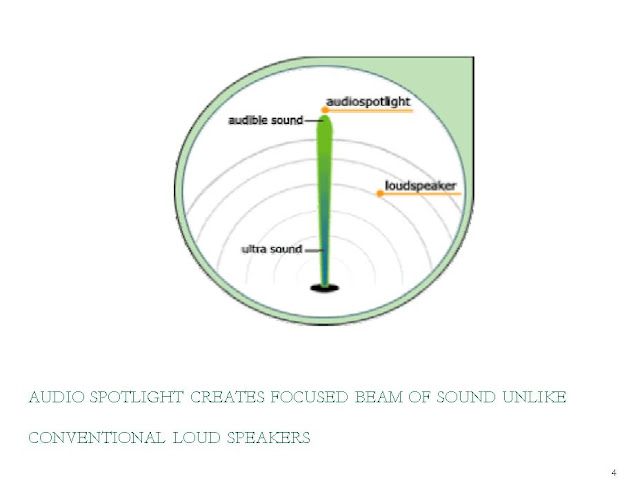
INTRODUCTION n Audio spot lighting is a very recent technology that creates focused beams of sound similar to light beams coming out of a flashlight. By ‘shining’ sound to one location, specific listeners can be targeted with sound without others nearby hearing it, ie to focus sound into a coherent and highly directional beam. It uses a combination of non-linear acoustics and some fancy mathematics. But it is real and is fine to knock the socks of any conventional loud speaker. n The Audio Spotlight & Hyper Sonic Sound Technology (developed by American Technology Corporation), uses ultrasonic energy to create extremely narrow beams of sound that behave like beams of light. Audio spotlighting exploits the property of non-linearity of air. When inaudible ultrasound pulses are fired into the air, it spontaneously converts the inaudible ultrasound into audible sound tones, hence proved that as with water, sound propagation in air is just as non-linear, and can be calcul...
INTERFACING OF EEPROM with 8051
7.1 Introduction As we know, ROM is a memory that does not lost its contents when the power is turned off. For this reason ROM is also called Non-Volatile Memory. There are different types of ROM such as PROM, EPROM, EEPROM, Flash EPROM and Mask ROM. In which PROM refers to the Kind of ROM that the user can burn information into. PROM is a user programmable memory. PROM is referred to as OTP (One time programmable). EPROM was invented to allow making changes in the contents of PROM after it is burned. In short, one can program the memory chip and erase it thousands of time. This is especially necessary during development of microcontroller based project. EEPROM is electrically erasable programmable ROM. EEPROM has several advantages over EPROM. EEPROM does not require external eraser and programming device. Flash EPROM has become a popular user programmable memory chip. The reason behind that is the eraser of entire content takes less than a second that why it is named Flash memory. Wh...
Comments